June 14, 202615 min read
Professional Website Design: The Difference Between a Website that Sells and One that Goes Unseen
Professional web design is a strategy starting with structural architecture for AI comprehension, ending with visual aesthetics that humans love to drive sales.
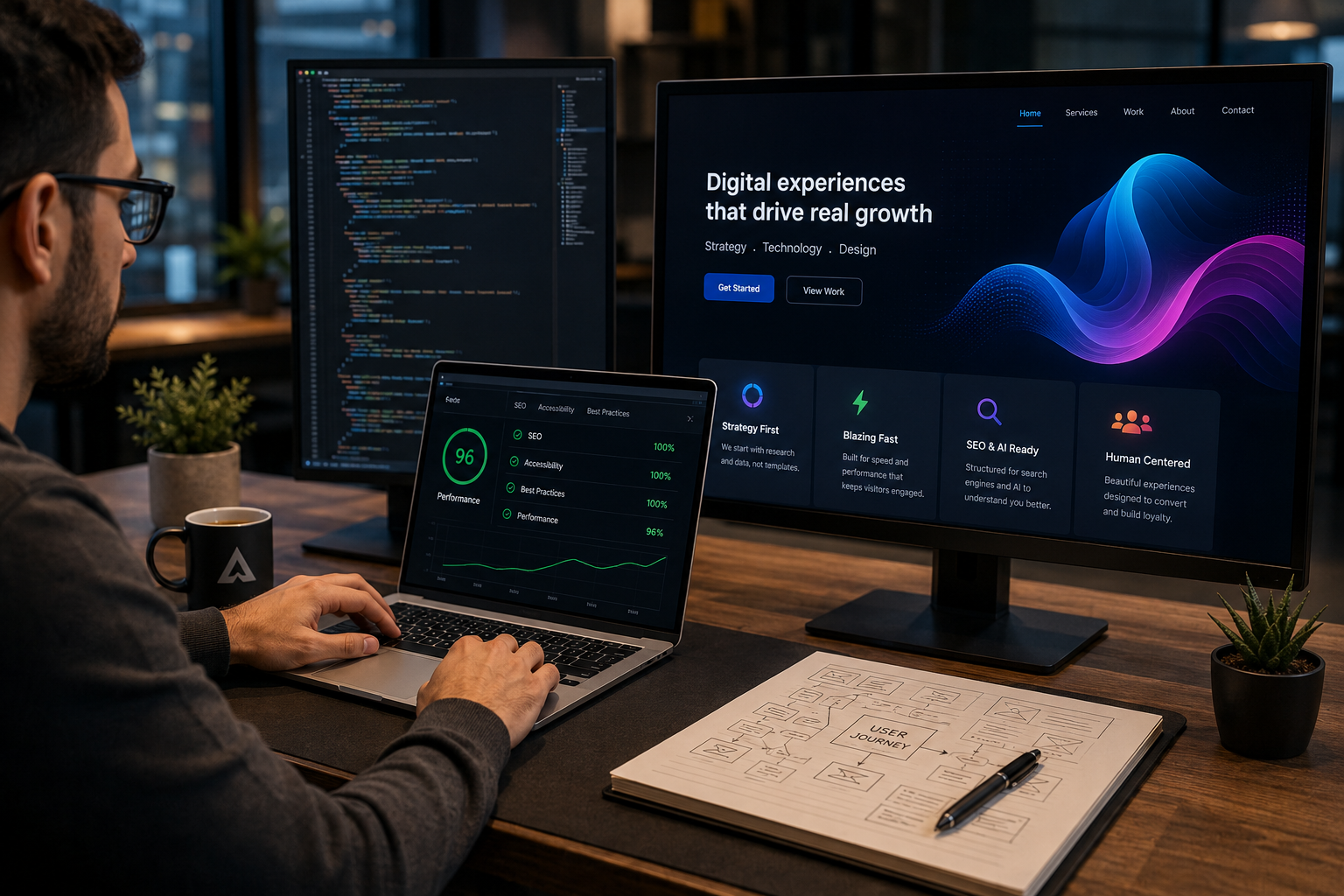
Typically, the design and development of any new website begins with a focus on visual aspects, such as layout, color schemes, animations, navigation menus, logo size, and the like. Conversely, discussions rarely touch upon those hidden details that do not meet the eye.
From this perspective, A2M calls this concept "Strategic Website Design" out of a desire to foster a culture of attentiveness toward these invisible aspects, ensuring they receive the same level of importance and momentum that visual elements enjoy.
In this article, we will shed light on the importance of considering all dimensions of professional website design, and how to choose the right design agency.
The Importance of the Invisible Side in Professional Website Design
The hidden side of a website is the actual engine that ensures the message is ultimately delivered.
Numerous reports, particularly in the cybersecurity sector, confirm that traffic generated by "software bots" visiting our websites has already surpassed human visits.
With the current dominance of search engines, AI platforms, and application programming interfaces (APIs), machines have become the primary browsers of websites compared to humans.
Being machines, they do not pay attention to attractive colors, elegant fonts, or eye-catching animations that captivate humans. Instead, their focus is entirely directed toward other details, such as the website's Semantic Structure, the coherence and architecture of information, and the site's ability to deliver organized and comprehensible data.
Websites that Ignored the Invisible Side Are No Longer Visible
Websites that neglect semantic structure go unseen; search engines stop indexing them, and algorithms cease to recommend or reference them.
This directly translates into dropping sales, a drought in potential lead generation, and a sharp decline in subscriptions—ultimately collapsing all human interaction with the website.
On the other hand, websites that anticipated this shift and addressed search engine optimization (SEO) and accessibility (Accessibility) challenges—by adopting robust semantic structures and machine-optimized content—have successfully maintained the sustainability of their business, even if they experienced a temporary dip in traffic.
Once machines understand and respond to you, you will automatically reach humans and align with their new ways of searching and making purchasing decisions.
We are in 2026, and a website that machines cannot read and understand is clinically dead, or at best, completely invisible.
The Triad of Strategic Website Design
Designing a professional website relies on three fundamental targets:
Humans: Who access the website across various devices, whether desktops or mobile phones.
Machines: Which require a sound semantic structure, fast loading speeds, technical usability, and data consistency to interpret and index content correctly.
Business Goals: Whether it is generating leads, building trust, or establishing brand authority.
An excellent website is one that serves all three objectives simultaneously through outstanding, professional design.
From Traditional Web Design.. to Strategic Design
"Strategic Web Design" hinges on the fact that a website has always been, and will continue to be, a purely strategic decision. It begins with fine-tuning the structural architecture first, and ends with visual choices and aesthetics second.
To define this structure—or information architecture—we must launch from thorough search engine optimization (SEO) research.
This research maps out the content and navigation flow within the site, dictating how pages are built and interconnected, all the way to crafting the final layout and user experience (UX).
All these steps intertwine to create a strategic impact that works in favor of every single visitor who lands on our site.
Consequently, overlooking this calculated sequence is not just a minor slip; it is akin to a deliberate waste of a golden opportunity.
The Relationship Between Accessibility and SEO
The comprehensive structural framework we just discussed, which is optimized for search engines, is the exact same foundation that makes a website highly compliant with accessibility standards. This, in turn, boosts its interaction with automated systems and software.
A website with a clear and well-defined semantic structure is easily read and understood by any automated system, just as it allows assistive technologies (like screen readers) to seamlessly help a blind person navigate it.
If this human and technical side does not convince you, let us look at the numbers and revenue:
Statistics show that websites implementing proper accessibility standards achieve, on average, a 27% increase in organic search rankings and a 23% growth in traffic. All of this happens without adding new content or spending a single dollar on advertising.
Think About the Essence of the Website.. Before Thinking About its Appearance
It is exponentially easier to start with the design of the website and focus on its dazzling visual elements than it is to dive into keyword lists, analyze competitors' traffic, scout for market gaps to exploit, and then merge all this data to build a cohesive structure understood by humans and machines alike.
The true challenge lies in creating engaging, concise content that gives the page its value and relevance, without turning it into a cold, automated text stuffed with buzzwords just for the sake of it.
Yes, meeting a minimum requirement of 600 words might seem daunting, especially since we know humans often lack patience and rarely read thoroughly. But let us be realistic: unlike humans, machines read everything, no matter how long or tedious the text.
And if a machine can read and comprehend your content, it rewards you with a new visitor, a hot lead, or a completed sale.
It is fun to see visual elements moving on your screen like puppets, but if you want to leave a real impact and drive revenue, you must invest the effort into "Thinking First.. Designing Second."
If You Want Tangible Results, Treat Web Design as a Strategy
Do not build a website just to have a digital presence; build it as a real investment that speaks on your behalf and represents you powerfully in the market.
In today's world, it is incredibly easy to hire any digital agency to design and develop any website you want. But without factoring in what we discussed, you will turn into just another carbon copy standing in line next to thousands of identical sites.
Because platforms and tools are available to everyone, we have all become—regardless of the varying time and money invested—like a monkey sitting in front of a typewriter, hitting keys at random hoping to produce a miracle.
And this is precisely what A2M understands.
How A2M Understands You and Your Website Design Philosophy
A2M realizes that your website is far bigger than a mere visual interface; it is a purely strategic decision and a long-term investment that represents you in the market.
Therefore, we do not design just for the sake of presence; we start exactly where true thinking should begin: from the invisible elements and information architecture.
At A2M, we completely understand the complex dynamic of 2026. To ensure your website does not become invisible in the digital space, our engineering team builds a fortified semantic structure developed with cutting-edge technologies like React and Next.js.
We optimize your site for machines and search engines first via Server-Side Rendering (SSR) to guarantee blazing-fast loading speeds that keep bounce rates at an absolute minimum. Simultaneously, our designers meet at the intersection of psychology, art, and technology to map out intuitive user journeys (UX) focused on conversion and sales.
With A2M, you will never be just another copy in the market. We merge deep user research with scalable design systems to secure your business sustainability, ensuring you win the trust of the machines that index your site, and the loyalty of the humans who browse and buy from it.
🚀 Do Not Be Invisible.. Make Your Website an Absolute Revenue Engine Today!
Stop wasting money on "templated interfaces" that search engines cannot see. Start today with A2M to design a professional website that AI understands, humans love, and that delivers genuine returns on your investment.
Contact us now.
Frequently Asked Questions (FAQs)
What is "Strategic Web Design" and how does it differ from traditional design?
It is engineering a website with a marketing mindset that starts with the hidden technical structure and SEO first to guarantee visibility, and leaves visual choices second; unlike traditional design, which solely focuses on external aesthetics.
Why does A2M insist on prioritizing machines and search engines?
Because 2026 data proves that bots and AI browse websites more than humans do. If a machine cannot interpret and crawl your site properly, human visitors will never be able to find it in the first place.
How do "Accessibility" features contribute to increasing my revenue?
Accessible websites are remarkably easy for automated search crawlers to read, granting them—according to statistics—a 27% boost in organic rankings and a 23% growth in traffic without ad spend.
What technologies does A2M use to ensure my website outperforms competitors?
We rely on modern, scalable stacks like React, Next.js, and Node.js, focusing heavily on Server-Side Rendering to deliver ultra-fast speeds that minimize bounce rates and maximize user retention.
Does focusing on the technical structure mean the website's look will suffer?
Absolutely not. UI/UX designers at A2M work at the intersection of psychology and digital art to craft stunning, seamless user journeys that audiences love while driving high conversion rates.